L2+ vs L3 Managed PoE Switches: Key Differences & Selection Guide
When designing robust network infrastructures for enterprise campuses, industrial automation, or large-scale security surveillance, choosing the right core hardware is critical. At the heart of modern edge-to-core deployments lies a pivotal architectural decision: selecting between an L2+ Managed PoE Switch and an L3 Managed PoE Switch.
While both options deliver data and high-power electrical current over a single Ethernet cable, their internal routing capabilities, deployment environments, and target topologies differ significantly. This guide breaks down the core technical differences, highlights ideal use cases, and provides a strategic selection framework for system integrators and B2B brand buyers.
1. Understanding the Core Architecture
To choose the optimal managed PoE switch, you must first understand how each tier handles data forwarding and network traffic management.
What is an L2+ Managed PoE Switch?
An L2+ Managed PoE Switch (often referred to as Layer 2 Plus or Lite L3) is fundamentally a Layer 2 data-link device that incorporates limited Layer 3 functionality—specifically, Static Routing.
- Data Forwarding: Operates primarily on MAC addresses for high-speed frame switching within local networks.
- The "Plus" Advantage: Supports static routing to allow basic communication (inter-VLAN routing) across different subnets without requiring a heavy external router.
- Industrial Hardening: Frequently paired with industrial-grade specifications such as wide operating temperatures (-40°C to 75°C), ERPS ring protection (sub-second failover), and high surge protection (e.g., 6KV) for harsh outdoor deployments.
What is an L3 Managed PoE Switch?
An L3 Managed PoE Switch (Multilayer Switch) combines high-speed hardware switching with advanced, wire-speed IP routing engines.
- Dynamic Routing Protocols: Supports advanced dynamic routing protocols such as OSPF (Open Shortest Path First), RIP, and VRRP, enabling automatic topology updates across complex multi-subnet networks.
- Enterprise Core Integration: Designed to act as the core or aggregation switch in large-scale environments, efficiently routing traffic between dozens of independent VLANs and subnets at maximum throughput.
2. Technical Comparison Matrix
| Technical Dimension / Parameter |
L2+ Managed PoE Switch |
L3 Managed PoE Switch |
| Primary OSI Layer |
Layer 2 + Static Routing |
Layer 2 + Full Dynamic Routing (OSPF, RIP) |
| Routing Protocol Support |
Static Routes, IPv4/IPv6 |
OSPFv2/v3, RIPv1/v2, Static Routing |
| Power Delivery (PoE) |
IEEE 802.3af/at/bt (Up to 90W PoE++) |
IEEE 802.3af/at/bt (Up to 90W PoE++) |
| Environmental Hardening |
Industrial Wide-Temp (-40°C to 75°C), Din-Rail |
Standard Commercial / Enterprise (0°C to 50°C) |
| Resilience & Redundancy |
ERPS Ring (<50ms recovery), STP/RSTP/MSTP |
VRRP, STP/RSTP/MSTP, Link Aggregation (LACP) |
| Typical Target Application |
Outdoor perimeter security, ITS, smart city edges |
Enterprise office backbones, data centers, campus cores |
3. Key Selection Guide: When to Choose Which?
Aligning your hardware procurement with exact network topography prevents performance bottlenecks and unnecessary capital expenditure.
Choose an L2+ Managed PoE Switch when:
- Deploying Outdoor Edge Surveillance: Ideal for intelligent traffic systems (ITS), oil & gas pipelines, and perimeter security where devices face extreme weather (-40°C to 75°C) and require reliable fiber uplinks with ERPS ring protection to prevent video stream drops.
- Powering High-Wattage Edge Devices: Supplying stable power to high-draw PTZ cameras, multi-sensor security domes, and Wi-Fi 7 access points using IEEE 802.3bt (90W PoE++).
- Managing Simple Inter-VLAN Segregation: When your network segmentation requires basic static routing between local subnets without the complexity and overhead of dynamic routing protocols.
Choose an L3 Managed PoE Switch when:
- Building Enterprise Campus Backbones: Handling high-density traffic across multi-floor office buildings or large commercial complexes requiring extensive subnet division.
- Needing Dynamic Route Optimization: Requiring automated path recalculation via OSPF to maintain zero-downtime data delivery across complex multi-router enterprise topologies.
- Controlling High-Throughput Core Aggregation: Connecting multiple downstream L2/L2+ access switches to a central distribution point with demanding high-throughput requirements.
4. B2B Procurement Considerations for System Integrators & Brands
For global brand owners and system integrators sourcing hardware from OEM/ODM manufacturers, technical parameters are only half the battle. Successful deployment and long-term brand reputation rely heavily on three critical pillars:
- Over-Provisioning Prevention: Avoid deploying costly L3 switches at simple edge sites where an L2+ Managed PoE Switch with static routing completely fulfills the requirement, thereby optimizing hardware budgets.
- Build Quality & Compliance: Ensure switches undergo rigorous laboratory aging tests and carry international certifications (CE, FCC, RoHS, UL) to guarantee compliance in mission-critical deployments.
- Customization & Supply Chain Stability: Partner with reliable manufacturing partners capable of providing flexible firmware customization, private labeling, and robust component-sourcing resilience.
HIGH‑DENSITY MANAGED POE SWITCH
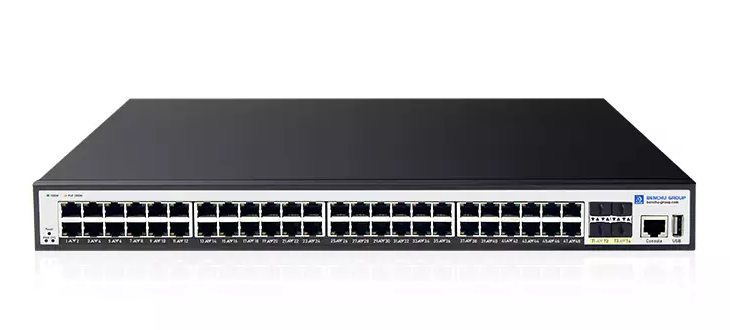
48 Port Full Gigabit Managed PoE Switch With 4 Gigabit SFP Uplink
Model: SP7500‑48PGE4GF‑L2M
- High‑Density Configuration: 48×10/100/1000Mb RJ45 PoE+ ports, total power budget up to 500W for PTZ cameras, outdoor APs and surveillance endpoints.
- Uplink Connectivity: 4×1G SFP fiber uplink slots for long‑distance industrial ring networking.
- L2+ Industrial Feature: Full L2 suite plus IPv4/IPv6 static routing, ERPS millisecond ring protection, VLAN, QoS, LACP, IGMP, MSTP.
- Industrial & Manageability: Wide‑temp hardware, Din‑Rail mount, secure SSH/ACL/802.1X, supports WEB / CLI / SNMP management.
HIGH‑DENSITY MANAGED POE SWITCH
Managed 48 Port Gigabit PoE Switch With 4‑10Gb SFP+ Uplink
Model: SP7500‑48PGE4TF‑L3M
- High‑Density Configuration: 48×Gigabit PoE+ ports, up to 500W total power budget for IP cameras, enterprise APs and IP terminals.
- Uplink Connectivity: 4×1G/2.5G/10G SFP+ high‑speed uplink slots for enterprise core aggregation.
- Layer3 Routing: Full L3 routing stack: static routing, OSPF, RIP, VRRP for multi‑subnet enterprise segmentation.
- Security & OEM: VLAN/QoS/ERPS plus SSH, ACL, AAA, 802.1X/RADIUS/TACACS+; supports white‑label OEM/ODM customization.
Frequently Asked Questions (FAQ)
Q1: What is the main functional difference between an L2+ and an L3 managed PoE switch?
A: An L2+ managed PoE switch supports static routing exclusively for local inter-VLAN communication, whereas an L3 managed PoE switch supports dynamic routing protocols such as OSPF and RIP, making it suitable for complex multi-subnet enterprise networks.
Q2: Is an L3 switch necessary for outdoor PoE surveillance applications?
A: In most outdoor edge-access PoE scenarios, an L3 switch is unnecessary. L2+ static routing, wide-temperature design (-40°C to 75°C), surge protection, and VLAN capabilities fully suffice for security architectures.

 Свяжитесь с нами по электронной почте
 Позвоните нам
 Адрес
Адрес



 Поддерживается сеть IPv6
 русский