Factory Specs & Quotes
Get unbranded (white-label) PDF datasheets and custom MOQ options directly from our engineering team. Fast 24-hour response. 100% Privacy Guaranteed. No spam.

Powering off-grid security systems using traditional AC inverters introduces critical conversion losses up to 30%. By replacing inverters with a direct 12V to 48V/56V DC booster or an integrated industrial solar PoE switch, engineers eliminate DC-AC-DC double conversions, optimize battery runtime, and significantly reduce solar hardware footprint and total cost of ownership (TCO).
Designing an efficient off-grid solar CCTV power system requires careful management of every single watt. In remote surveillance installations, the native power source is direct current (typically a 12V or 24V solar battery bank), while the edge devices—such as IP cameras and wireless bridges—demand high-voltage direct current (48V to 56V) via Power over Ethernet (PoE). Bridging this voltage gap is where many system integrators make a critical design mistake: they deploy commercial-grade AC inverters to power DC-based PoE devices.
An AC inverter's job is to take low-voltage DC from your batteries, convert it to high-voltage AC (110V/220V), and then feed it to the standard PoE power adapters. However, those power adapters immediately convert that AC power back down to 48V or 56V DC to feed the PoE switch.
This "double conversion" process creates massive AC inverter power loss through heat dissipation. In addition, AC inverters consume a constant "idle power draw" (self-consumption) even when the security cameras are not transmitting data. In winter or consecutive cloudy days, this continuous conversion overhead can drain battery banks prematurely, leading to critical camera blackouts.
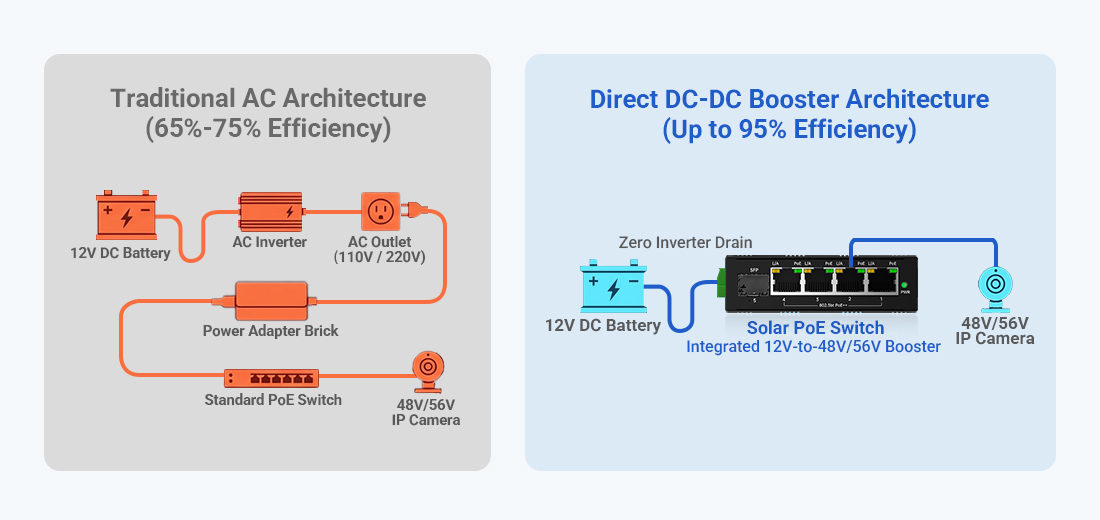 Flowchart demonstrating the multi-stage conversion losses of AC inverters compared to the high-efficiency direct DC-DC boost path.
 | Architecture Specs | Traditional AC Inverter Setup | Direct DC-DC / Solar PoE Switch |
|---|---|---|
| Power Path | DC (12V) → AC (110V/220V) → DC (48V/56V). Highly complex. | DC (12V/24V) → DC (48V/56V). Single-stage conversion. |
| Power Efficiency | Approx. 65% - 75% overall (Heavy losses due to heat and idle draw). | Up to 95% efficiency. Minimizes self-consumption. |
| Physical Footprint | Bulky. Requires inverter, power strip, and separate PoE adapters. | Ultra-compact. DIN-Rail mounted switch with built-in booster. |
Eliminating the AC inverter is highly beneficial, but replacing it with cheap, modular, standalone DC converters can introduce loose connections, electromagnetic interference, and unstable voltages. The engineering solution is to integrate a ruggedized industrial solar Powered PoE switch equipped with an on-board boost regulation circuit. Here is why this delivers unmatched advantages:
Instead of multiple power conversion devices, an industrial solar switch accepts direct 12V or 24V DC battery input and steps it up cleanly to stable 48V/56V PoE voltage. This built-in 12V to 56V step-up regulator is engineered directly on the primary board. Under severe load variations, it maintains a rock-solid voltage, preventing camera disconnects and ensuring that power-hungry PTZ units function reliably without dropping packets.
Outdoor security systems often deploy advanced PTZ domes, multi-sensor cameras, or long-range wireless backhauls. These edge devices demand robust power delivery. Industrial solar switches natively support 802.3at/bt high-power PoE, outputting up to 60W or 90W on a single port. By handling step-up boosting internally, the switch guarantees that high startup current surges from motors and infrared illuminators do not collapse the system's power rail.
AC inverters and bulky power bricks generate intense heat inside small, sealed outdoor solar enclosures. Excessive heat accelerates battery degradation and triggers standard network hardware shutdowns. Industrial solar switches use highly efficient solid-state components that generate minimal heat. Housed in a fanless IP40 metal casing, they easily withstand extreme ambient temperatures from -40°C to 75°C, ensuring continuous operation inside small weatherproof cabinets.
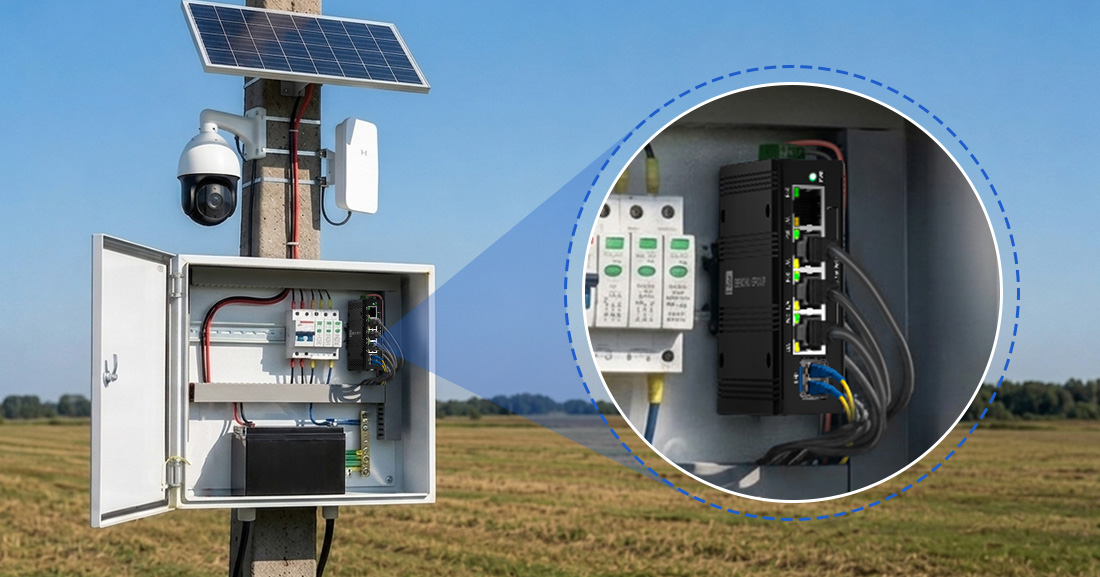 Realistic layout of an off-grid pole-mounted CCTV system featuring an industrial solar switch and battery pack in a sealed enclosure.
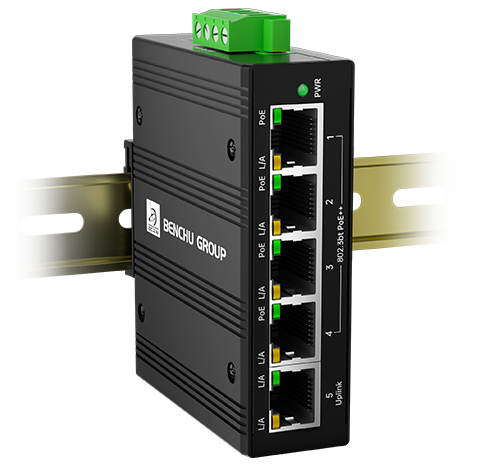
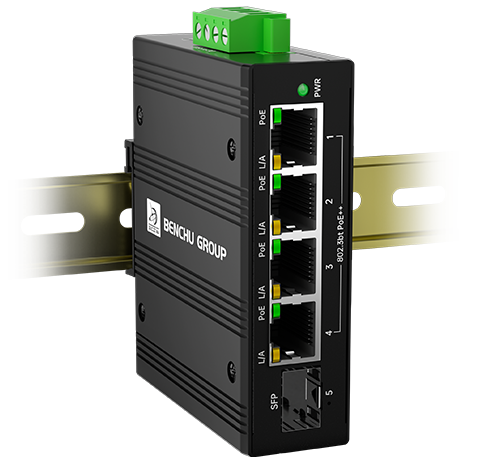
 Engineered specifically for remote solar CCTV deployment. These industrial switches integrate high-performance DC boost circuits to directly power high-wattage security devices.
The system efficiency gains of direct DC boosting translate directly into financial savings. A 20% to 30% reduction in power transmission loss means your off-grid system requires less daily battery capacity and fewer solar panels to guarantee a stable 24/7 charge.
By upgrading to a smart, integrated DC-DC boosting network topology, operators save thousands of dollars per site in heavy solar arrays and battery hardware. More importantly, they eliminate the most common point of failure in remote setups—faulty commercial AC inverters.
Stop wasting battery power on unnecessary DC-to-AC inversions. Contact our field engineering team today to configure a highly efficient, direct-boost PoE network tailored to your specific deployment.
Get Free System Sizing & Bulk Pricing Свяжитесь с нами по электронной почте
 Позвоните нам
 Адрес
Адрес
5F, Block5, GuangmingGu Industrial Park, Matian Villiage, Guangming Disitrict, Shenzhen, China



 Поддерживается сеть IPv6
 русский